
You Can’t Manipulate What You Don’t Understand
Why following tutorials creates an illusion of competence—and what disassembled VCRs taught me about first-principles problem-solving.
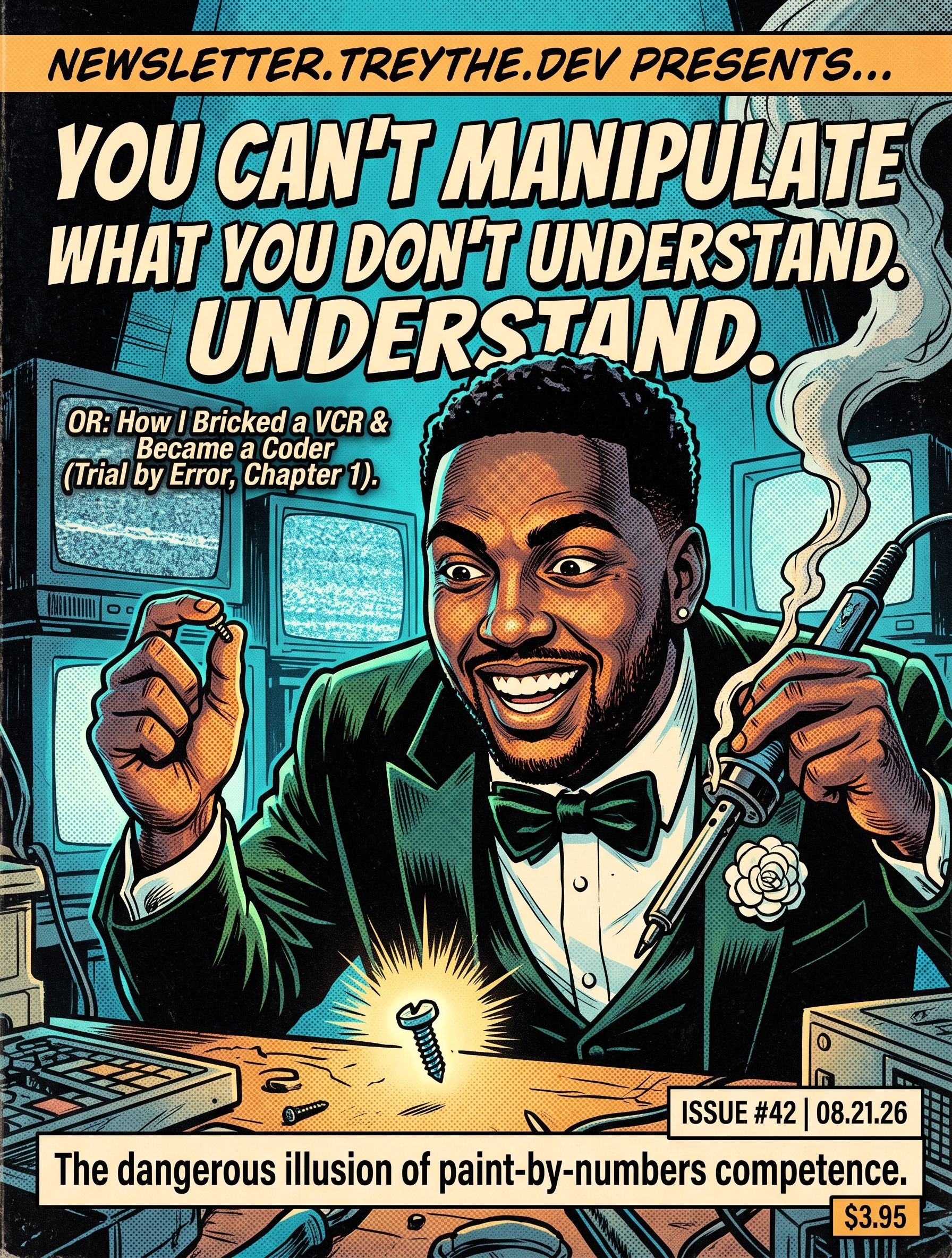

The dangerous illusion of paint-by-numbers competence.
If you entered my childhood bedroom between 1998 and 2006, you were stepping into a mechanical crime scene.
There was usually a disassembled VCR on the rug, a stripped-down bicycle frame leaning against the closet, and the family computer sitting with its steel chassis exposed like a patient mid-open-heart surgery. My parents would walk in, take one look at the small mountain of leftover screws on my desk, and sigh.
I wasn't an engineer. I was just an unhinged, impossibly hard-headed kid with a screwdriver who was hopelessly obsessed with seeing the seams of reality.
Sure, half the time the VCR never ate a tape again, and the family PC took a three-week "vacation" while I frantically tried to remember which ribbon cable went where. But I learned something vital in the wreckage: you cannot respect the magic of a machine until you’ve held its gears in your hands.
It wasn't just about breaking things. My entire life, I have been fundamentally incapable of taking an answer "for what it was." When a teacher, a manual, or an expert handed me a fact, my brain didn’t process it as data. It processed it as a dare.
I questioned the mechanism, but more importantly, I questioned the theory behind the mechanism. I challenged the person giving the explanation—not just to be difficult, but to test if they actually understood their own premise or if they were just repeating inherited dogma.
"Yeah, I hear the rule. But why? Prove to me you actually believe it."
If I was going to follow a path, I needed to know the logical map was real—not just "because that's how it's always been done."
Fast forward a decade. I decided to learn how to write software.
Naturally, I did what everyone does: I bought the courses. I watched the 40-hour video series. I followed the instructor line by line, typing what they typed, feeling like a modern digital wizard. My code compiled! The app ran! I was a genius!
Until I closed the video.
The moment I stared at a blank screen and tried to build something not mapped out in the tutorial, my brain turned into static. I had copied the keystrokes, but I hadn’t absorbed the physics. I was an actor reading lines in a language I didn’t actually speak.
I vented this frustration to a mentor, convinced I just wasn't "wired" for programming. He cut me off mid-whine with seven words that permanently altered the way I interact with the world:
"You can’t manipulate what you don’t understand."
It hit like a bucket of ice water. Following a recipe isn't cooking. Driving a route on Google Maps isn't navigation. And copying a template isn't problem-solving.
We live in a world designed around frictionless abstractions. We inherit codebases, marketing playbooks, productivity hacks, and second-hand opinions without ever asking what holds them together beneath the surface. We trade genuine mastery for the cheap high of feeling productive.
Ask yourself right now: Where in your work or life are you simply following a tutorial? What system are you operating every single day that would completely stall out if the manual suddenly vanished?
Real problem-solving requires returning to that hard-headed, infuriating kid with the screwdriver. It means abandoning the step-by-step guide, picking a project that terrifies you slightly, and accepting that you’re going to hit wall after wall of trial and error. You have to break the system on purpose, stress-test its edges, and ask the "Five Whys" until you hit the raw bedrock of reality. You have to demand the theory, challenge the expert's confidence, and hold the gears yourself.
It’s frustrating. It's slow. It will leave you with a pile of metaphorical "extra screws" on your desk.
But when the thing finally works? It works because you commanded it—not because you copied it.
The Friday Question
Think back to the last time your hard-headedness actually paid off. What premise did you refuse to accept, what 'expert' did you challenge, and what definitive, bedrock truth did you uncover by being absolutely, delightfully difficult?
Drop your best stubborn story in the comments. Let's see who is the reigning champion of "Refusal to Take Yes for an Answer."
Catch you next Friday—when we talk about why your best ideas only show up the exact second you stop trying to have them.
Enjoyed this post?
Get posts like this one in your inbox, once a week.
One email a week, no spam, unsubscribe anytime. Join 85 subscribers.



Comments (2)
Leave a comment
I'm a firm believer in this school of thought. My father used to tell me, Ding-dong an understanding is the best thing in the world. Thanks Pop.❤️
Pinned author note: The uncomfortable truth I had to swallow while writing this is that 90% of what we call 'expertise' is just high-level tenant behavior. We know how to turn on the lights, adjust the thermostat, and complain when the plumbing leaks—but almost none of us know where the main water line actually connects to the street. In tech, in corporate strategy, and in our personal beliefs, we rent certainty from people who built the house decades ago. It feels efficient until the foundation shifts. If you stripped away every pre-packaged framework, third-party library, or inherited rule you lean on to do your job tomorrow, how much of your actual output is original logic versus pattern matching?