
The AI Tourist vs. The Delegator: How I Stopped Praying to the Prompt Box
The first time you use AI, it feels like magic—until you actually try to build something. Here is how I went from hoping the prompt box would do my job to treating AI like a brilliant but chaotic intern.
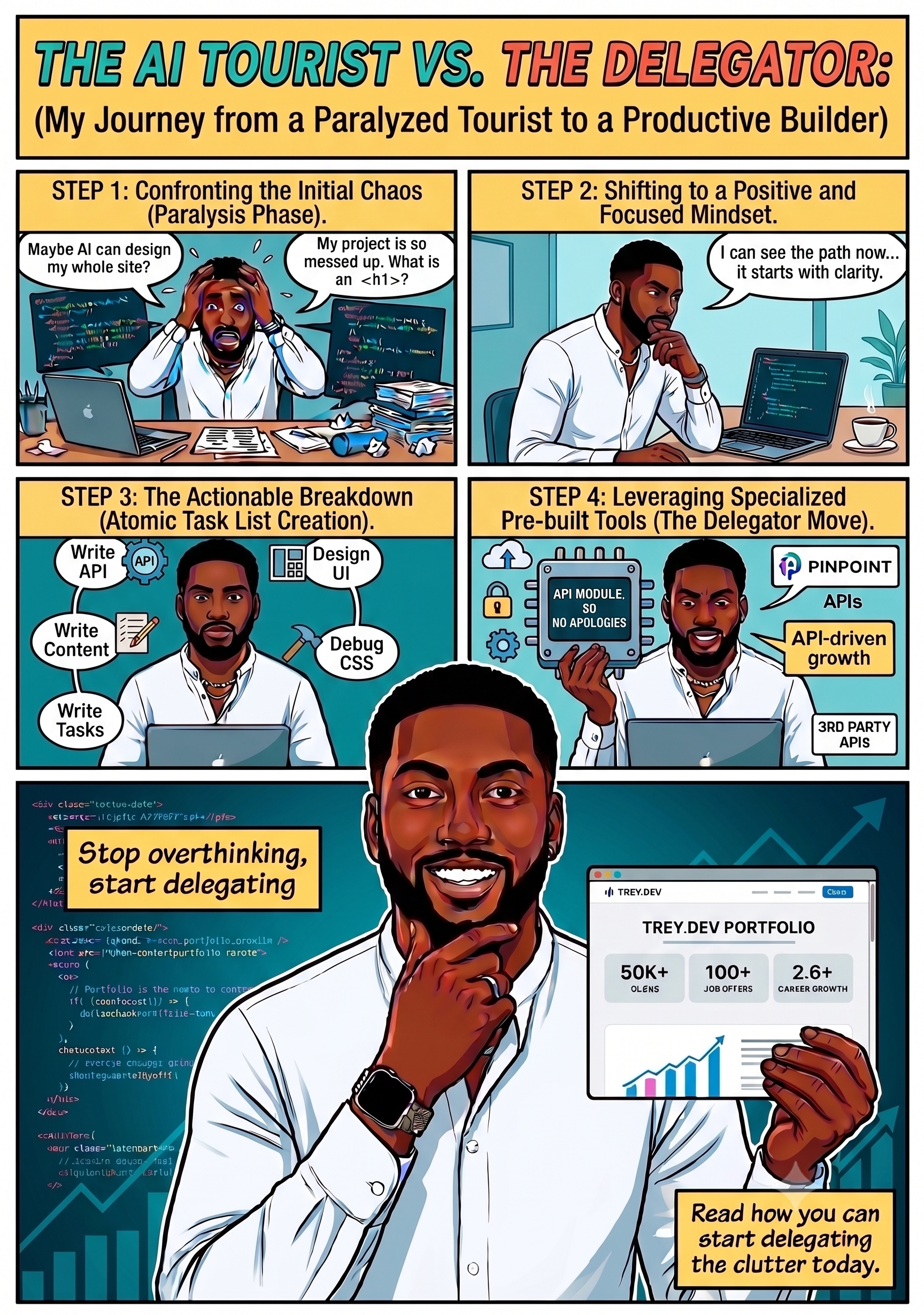

The first time you use AI, it feels like literal witchcraft. You type a grammatically incorrect sentence into a little text box, and a ghost in the machine types back. It writes a haiku for your mom. It explains quantum physics in the style of a 1990s surfer. You sit back, take a sip of your coffee, and think, "The future is here, and I am a wizard."
Enjoy that feeling. Because it lasts exactly until you try to use it to get real, high-stakes work done.
Suddenly, the magic evaporates. You ask it to help you finish a project, and it spits out generic, lukewarm corporate fluff. You ask it to fix a bug, and it confidently gives you a solution using a library that doesn't exist. You click "Regenerate" over and over, essentially playing the slot machines with a prompt box, hoping the next roll of the dice actually gives you what you need.
Most people get stuck right here. They are AI Tourists. They visit the tech, take some mental photos, get frustrated when the AI refuses to magically read their minds, and walk away thinking it’s just a glorified parlor trick.
But there is a second tier. The Delegators. And crossing that bridge changes absolutely everything.
My Wake-Up Call: The Pinpoint Trenches
I had to learn this the hard way. When I was building Pinpoint, I was trapped in the ultimate Tourist cycle. I wanted to move fast, so I treated the AI like a magical co-founder who worked for free, never slept, and didn't ask for equity.
I’d throw a massive, incredibly vague demand at the prompt box:
"Build me a new location filtering feature that updates in real-time."
I’d hit enter, crack my knuckles, and wait for the machine to do my job for me.
The result? A 400-line hallucination of pure, unadulterated spaghetti code. The UI rendered upside down, my state management filed for emotional bankruptcy, and the AI confidently signed off with, "Hope this helps! 🚀 Let me know if you need anything else!"
It did not help. I spent the next three hours performing an exorcism on my own codebase, fighting the very tool that was supposed to save me time.
That was my breaking point. I realized my fatal mistake: AI isn’t a mind-reading senior partner. It is a brilliant, hyperactive intern who has memorized the entire internet but has absolutely zero common sense.
If you hire a human intern and say, "Hey, go scale our infrastructure," they will burn the building down. You haven't given them boundaries, constraints, or a definition of success. To get real value out of an intern, you have to break the grand vision down into microscopic, heavily managed tasks. You have to stop wishing for a result and start delegating the execution.
The Core Shift: Hoping vs. Directing
What separates a casual user from a professional isn't a secret tech background or a ridiculously expensive subscription tier. It’s a fundamental mindset shift from Hoping to Directing.
Tourists use AI to figure out what to do. Delegators already know exactly what the end state looks like; they use the AI strictly to speed up the execution of the steps to get there.
Look at how this plays out in everyday life, whether you are slinging code or just trying to survive your email inbox:
The Everyday User Shift: Writing an Email
- The Tourist (Hoping): "Write an email to my boss asking for a budget increase for our team's marketing tools."
- The Result: A rigid, 5-paragraph essay that sounds like it was written by a Victorian time-traveler who just discovered the word "synergy." Your boss will immediately know a machine wrote it, or assume you’ve been kidnapped.
- The Delegator (Directing): "You are an elite corporate strategist. Write a 3-sentence email to my boss, Sarah, asking for a $500 budget increase for our design software. Tone: urgent but respectful. Focus heavily on the fact that this tool will save our team 10 hours a week. Do not use the words 'delve,' 'testament,' or 'landscape.' Output only the email body."
The Technical User Shift: Building a Feature
- The Tourist (Hoping): "Write a React component for a map filter."
- The Result: A massive file filled with bloated libraries you don't even have installed, zero error handling, and placeholder code that just says
// TODO: add actual logic here.
- The Result: A massive file filled with bloated libraries you don't even have installed, zero error handling, and placeholder code that just says
- The Delegator (Directing): "Write a single, isolated React hook called
useLocationFilter. It must take an array of raw coordinate objects and return a sanitized array filtered by a radius variable. Handle null payloads by returning an empty array. Do not include markdown formatting, pleasantries, or explanations. Output only the executable code."
The Delegator's Toolkit: How to Level Up Today
If you want to stop touring and start delegating, you only need to implement three core principles into your daily workflow. Anyone can use these, whether you're coding an app or writing a newsletter.
1. Give it a Nametag (The Persona)
Before you tell the AI what to do, tell it who it is. A Large Language Model is a vast ocean of probabilities. If you don't constrain its personality, it defaults to a polite, incredibly generic customer service rep.
- Don't say: "Help me edit this paragraph."
- Do say: "You are a ruthless, cynical copyeditor for a major tech publication. Your job is to cut out fluff, passive voice, and corporate jargon. Make this punchy."
2. Micro-Tasking (The "Lay a Single Brick" Method)
Stop asking the AI to build the entire house. It will build you a house, but the doors will be on the ceiling and the toilet will be in the kitchen. Ask it to lay a single brick perfectly. If you have a massive report to write, ask it to outline the structure first. Then, feed it your raw notes and ask it to write Section 1. Then Section 2. I started doing this with Pinpoint—instead of asking for a feature, I asked for a single, mathematically verifiable function. It changed everything.
3. Establish the "Negative Space" (The Guardrails)
Professional prompt engineering is less about telling the AI what to do, and much more about telling it what NOT to do. Language models love to over-explain, apologize, and add conversational fluff. Cut the noise by setting explicit boundaries. Tell it exactly what words to avoid, what format to stick to, and precisely where to shut up.
The Takeaway
The gap between a casual AI user and a pro comes down to one thing: predictability. The Tourist hopes for a good outcome and gets frustrated by the chaos. The Delegator designs a system where a bad outcome is practically impossible.
AI is the most powerful lever we’ve ever been handed, but a lever only works if you know exactly where to place your weight. Stop whispering wishes into the prompt box. Figure out what you want, set aggressive boundaries, and start managing the machine.
Enjoyed this post?
Get posts like this one in your inbox, once a week.
One email a week, no spam, unsubscribe anytime. Join 85 subscribers.



Comments (1)
Leave a comment
What other insights can you give about using AI