
From the Gym to the Gutter: How Five Unrelated Hobbies Saved My Mind, My Relationship, and My Creativity
How stepping away from the endless grind and embracing five completely unrelated hobbies saved my relationship, boosted my creativity, and grounded me for the life-changing journey of fatherhood.
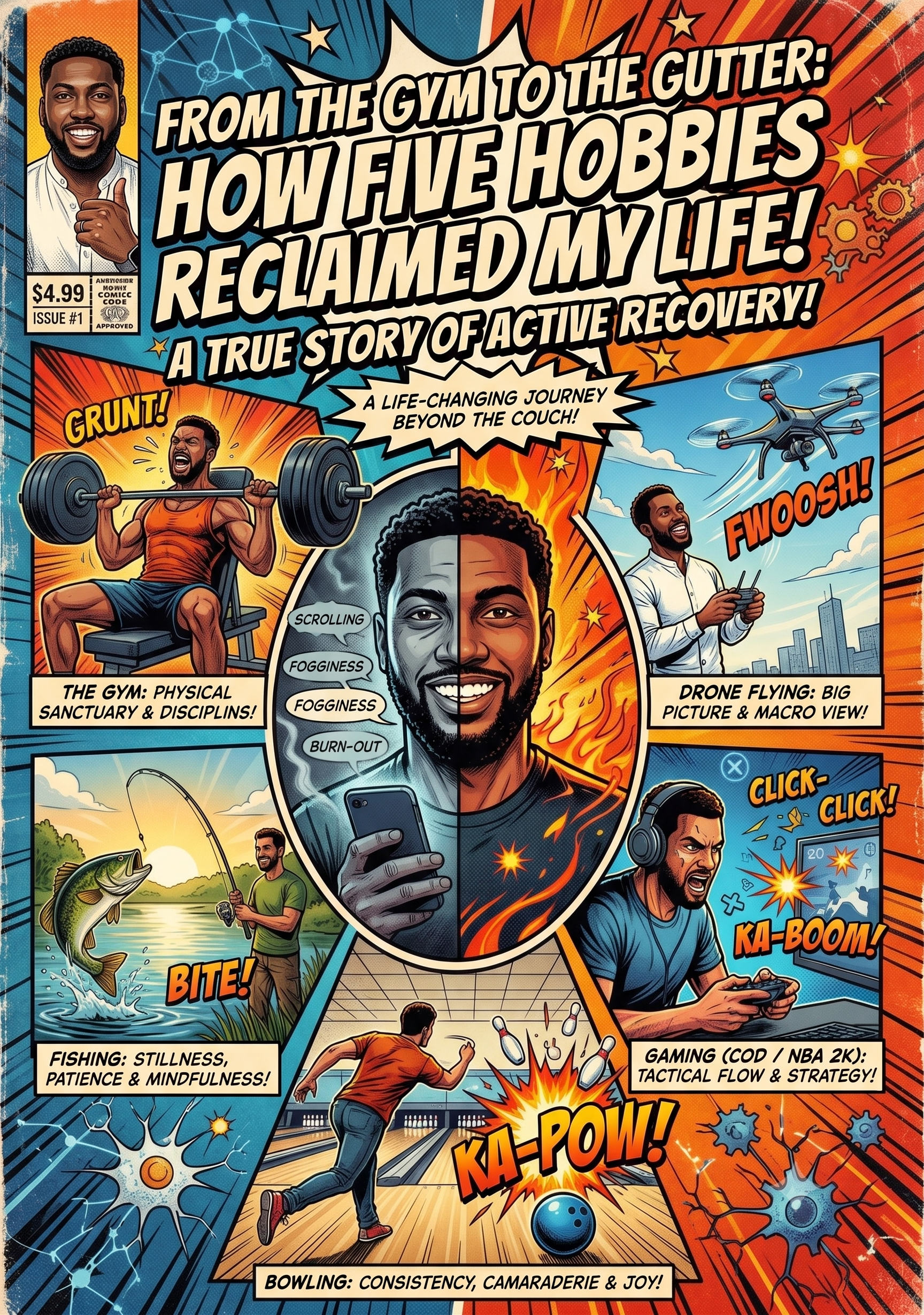

A few years ago, I caught myself doing what so many of us do when life gets overwhelming. I was working long hours, coming home entirely drained, and spending my evenings slumped on the couch, mindlessly scrolling through my phone while a show played in the background.
I told myself I was "recharging." But the truth? I felt more exhausted waking up the next morning than I did when I went to bed. My brain felt foggy, my work felt repetitive, and my personal life was slipping into a monotonous routine.
It wasn't until I started intentionally filling my free time with seemingly random pursuits—going to the gym, flying drones, fishing, playing Call of Duty and NBA 2K, and joining a bowling league—that I realized a crucial truth about human nature:
Passive rest doesn't rebuild you. Play does.
Here is the story of how stepping away from productivity culture and throwing myself into five totally unrelated hobbies completely reshaped my brain, saved my relationship, and changed the way I think about life.
Part I: The Discovery of "Active Recovery" (Why the Gym and Gaming Kept Me Sane)
For a long time, I viewed hobbies as a luxury—something you only deserve if you've checked off every single task on your to-do list. But when you operate on that mindset, you never get to play, because the to-do list never actually ends.
My first major shift happened when I stopped treating the gym as a chore and started treating it as a mental refuge. I realized that when I’m under a heavy barbell, my mind physically cannot wander to work emails, bills, or unpaid invoices. Moving heavy weight forces a total shutdown of mental noise and anchors you completely in the physical reality of the moment.
Shortly after, I noticed the exact same phenomenon when I booted up a console for a session of Call of Duty or NBA 2K.
When I’m locked into a high-stakes search-and-destroy round in Call of Duty—making split-second tactical decisions under pressure—or reading the defense to set up a clean play in NBA 2K, I enter what psychologists call the flow state. Time melts away. My brain isn't worrying about tomorrow's schedule or dissecting yesterday's mistakes; it's completely locked into the execution of the present moment.
I used to feel subtle guilt about spending an hour in the gym or behind a controller. But I began to realize these activities were providing active recovery.
While sitting on the couch merely paused my mental drain, engaging in active, focused pursuits actually recharged my battery. It gave my problem-solving brain a genuine, physiological break.
Part II: Shifted Perspectives (What Drone Flying and Fishing Taught Me About My Brain)
Once I saw the mental benefits of active recovery, I started leaning into other curiosities I'd put off for years.
I picked up drone flying, taking to open parks and clear skies. There is something profoundly therapeutic about standing on the ground and watching a live video feed from 200 feet in the air. When you look at the world from a drone's perspective, the roads, buildings, and obstacles that seem massive from the ground suddenly look small and organized. It literally forced me to practice stepping back and seeing the "macro view"—a skill I desperately needed in my everyday life.
On the flip side, I started spending early mornings out on the water fishing.
If drone flying is about high-altitude perspective, fishing is about absolute presence and patience. You can't force a fish to bite. You have to read the environment, pay attention to subtle movements in the water, adapt your strategy, and sit with stillness.
Without realizing it, learning these completely different skills was physically altering my brain. Every time I mastered a drone flight maneuver, adapted to a defensive scheme in NBA 2K, or adjusted a fishing rig for changing weather conditions, I was building new neural pathways (a process known as neuroplasticity). I wasn't just killing time; I was keeping my brain agile, curious, and resilient.
Part III: The Relationship Paradox & The Pregnancy Misconception
As my hobbies grew, so did a very real dynamic in my personal life. Early in my relationship, my partner and I fell into the classic trap of trying to do everything together. We shared the same couch, watched the same shows, and spent every evening in the exact same room. It felt safe, but over time, the spark started to dim. We ran out of interesting things to share, and if one of us wanted time alone, the other felt subtly rejected.
That changed when I started making time for my own individual pursuits—including a weekly bowling night.
At first, taking an evening away to throw heavy plastic balls at wooden pins felt a little selfish. But the impact on our relationship was almost immediate. Esther Perel, a renowned relationship therapist, often says that "fire needs air." Desire requires a little bit of distance. Going off to bowl, fly my drone, or hit the gym stopped me from expecting my partner to be my sole source of fulfillment, and gave us fresh stories to bring back to the dinner table.
The Misunderstanding: "He's Just Nervous"
This dynamic reached its most critical test when my wife got pregnant.
During those nine months of preparing for fatherhood, I continued leaning into my hobbies. From the outside, some people misread the situation entirely. Friends or family looked at me heading out to fish early in the morning, hitting the gym, or locking into a few matches of Call of Duty, and assumed it was nervous energy.
"He's just anxious about becoming a dad."
"He's just trying to get it out of his system while he still can."
The truth couldn't have been further from that.
I wasn't running away from the reality of fatherhood; I was grounding myself for it.
Preparing to welcome a child is one of the most profound, life-altering experiences a human can go through. I knew that to be the calm, steady, and present partner my wife needed—and the grounded father my child deserved—I couldn't operate from a place of chronic stress, mental exhaustion, or lost identity.
My hobbies weren't a sign of nervousness. They were my sanctuary. Standing quietly on a bank while fishing, feeling the rhythmic discipline of a heavy workout, or zoning in on a bowling alley lane was where I processed the weight of what was coming. It was where I found peace, regulated my nervous system, and centered myself so that when I walked back through the front door, I was 100% present, calm, and ready to be the anchor my family needed.
Part IV: My Theory on the "Hobby-Less" Mind
Through all of this, I developed a personal theory after observing the people around me:
I noticed that people who don't have hobbies often struggle with creativity, struggle to adapt socially, and lack the ability to find hidden connections between seemingly unrelated things.
Hobbies act as a cross-training ground for the human mind. When you only ever do one thing—like your job—your mental library is extremely small. You think linearly because you only have one set of experiences to draw from.
Look at what my five random hobbies were secretly teaching me:
| My Hobby | The Mental Muscle It Built | How It Showed Up in Real Life | The Gym | Progressive Overload & Patience | Taught me that real growth takes steady, incremental effort over time. | | Drone Flying | Spatial Awareness & Macro Framing | Taught me to step back and look at the "big picture" when stuck on a problem. | | Fishing | Environmental Reading & Stillness | Taught me to sit with uncertainty, stay patient, and process big life shifts. | | Gaming (CoD / NBA 2K) | Tactical Rhythm & Decision-Making | Taught me to keep a cool head, read complex situations, and react under pressure. | | Bowling | Process Refinement & Consistency | Taught me the value of routine, angle calculation, and rhythm under pressure. |
When I face a complex challenge at work or in my personal life, my brain doesn't just pull from professional experience. It pulls from the patience of fishing, the big-picture view of drone flying, the split-second decision-making of Call of Duty, the structural execution of NBA 2K, the steady discipline of the gym, and the precise consistency of bowling.
Learning to Fail Safely
Perhaps the greatest gift these hobbies gave me was a safe place to fail. In our professional or family lives, failure feels terrifying because the stakes are high. But what happens when you fail in a hobby?
- You throw a gutter ball on a strike attempt.
- You lose a lure on a submerged branch.
- You lose a match in Call of Duty or miss a clutch shot in NBA 2K.
- You fail a heavy lift at the gym.
The world doesn't end. You take a breath, laugh at your mistake, adjust your form, and load into the next round. Hobbies build a high tolerance for frustration in a completely low-stakes environment, teaching you how to fail gracefully in the real world.
Conclusion: Full Circle
If you looked at my life from the outside, you might see a disjointed list of interests: a guy who likes lifting weights, flying drones, standing by a lake, hopping on Call of Duty or 2K with friends, and bowling on weeknights.
But to me, these pursuits form a complete, balanced ecosystem:
- The Gym builds my body and physical discipline.
- Fishing calms my spirit and grounds me in nature.
- Drone Flying expands my perspective and triggers my curiosity.
- Gaming (Call of Duty / NBA 2K) keeps my mind fast, sharp, and competitive.
- Bowling brings rhythm, camaraderie, and low-stakes fun.
A hobby doesn't need to be a side hustle. You don't need to monetize it, and you certainly don't need to be a pro at it. Its true value lies in giving you a space to exist, play, and find yourself—especially when life is handing you major milestones.
If you've let your interests fade under the weight of everyday expectations, consider this your permission slip to pick them back up. Go buy the lure, grab the controller, or head to the gym. Your brain, your relationships, and your peace of mind will be infinitely better for it.
Enjoyed this post?
Get posts like this one in your inbox, once a week.
One email a week, no spam, unsubscribe anytime. Join 86 subscribers.
Comments (2)
Leave a comment
Finding positive ways to life . Can’t be stuck in the same mindset all your life . If you want change you will find positive and great things to change that mindset.
Awesome insight. This is the truth we need. Expanded horizons is the way to future proof your life in a positive way.